


How to Verify Trading Card Authenticity: A 2026 Guide
Table of Contents
- What You'll Need Before You Start Checking Cards
- How to Verify Trading Card Authenticity Using Print and Card Stock Checks
- How to Spot Fake Pokémon Cards
- How to Authenticate Sports Cards
- How to Verify a Graded Card Certificate and Slab
- When to Use Trading Card Authentication Services
- Common Mistakes to Avoid When Buying Trading Cards
- Frequently Asked Questions
Last Updated: 8 October 2026
What You'll Need Before You Start Checking Cards
Knowing how to verify trading card authenticity starts with a few simple tools. You do not need a lab. A bright lamp, a magnifying glass and a steady hand will catch most fakes.
A common mistake is skipping the basics. Most counterfeit cards fail on print quality, card stock or colour long before you need expert help.
Here is what to have ready:
- A bright desk lamp or daylight bulb
- A magnifying glass or jeweller's loupe
- A small kitchen scales that reads in grams
- A smartphone for checking certificates
- A known genuine card for comparison
The five checks below cover print, card stock, weight, grading and certificates. Together they catch the vast majority of fakes.
How to Verify Trading Card Authenticity Using Print and Card Stock Checks
The fastest way to verify trading card authenticity is to check print quality, card stock and weight. Fakes usually cut corners on all three.
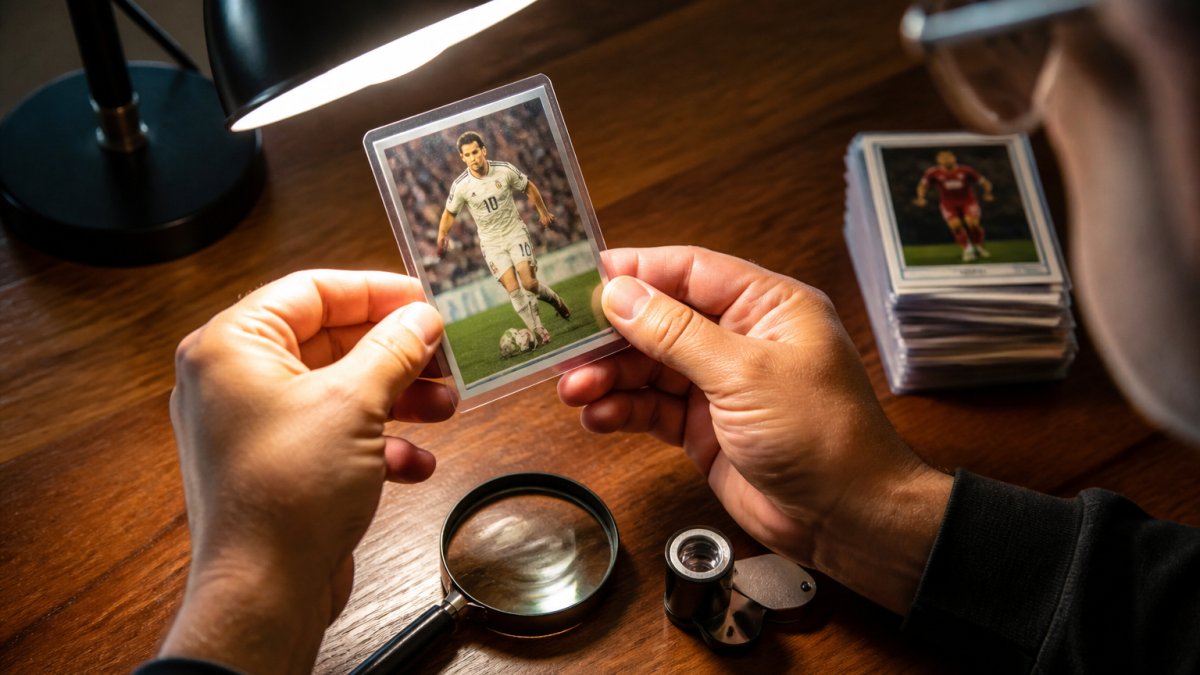
Checking Print Quality and Colour Registration
Genuine cards use sharp, high-resolution printing. Text stays crisp even under a magnifying glass. Colours sit evenly with no bleeding at the edges.
Counterfeits often look slightly blurry. Lettering may be soft or jagged. Colours can look washed out or too dark.
Look for these signs:
- Fuzzy or dotted edges on text
- Colours that sit outside the printed lines
- A finish that feels too glossy or too flat
- Misaligned layers when you tilt the card
The Bend Test, Light Test and Weight Test
The bend test checks flexibility. A genuine card springs back gently. Fakes often feel stiff or crack easily. Bend only slightly, never force it.
The light test uses a bright lamp. Hold the card up to the light. Genuine stock shows an even glow. Fakes may look patchy or too opaque.
The weight test needs a small scale. Most standard cards sit in a narrow weight range for their set. A card that feels too light or too heavy is worth a closer look.
| Check | What to Do | What a Fake Shows |
|---|---|---|
| Print quality | Use a magnifying glass | Blurry text, colour bleed |
| Bend test | Flex gently | Stiff or cracks |
| Light test | Hold to a lamp | Patchy, too opaque |
| Weight test | Weigh in grams | Too light or heavy |
How to Spot Fake Pokémon Cards
Fake Pokémon cards usually fail on colour, font and the back design. Check the back first, because it is the hardest part to copy well.
Genuine Pokémon cards have a deep blue back with a clean white border. The Poké Ball design sits sharp and centred. Fakes often show a duller blue or a slightly off-centre ball.
On the front, look at the font. Real cards use clean, consistent lettering. Fakes swap in similar fonts that look close but not exact.
Other quick checks:
- Energy symbols should be crisp, not fuzzy
- The card stock should feel firm, not flimsy
- Holo patterns should shift smoothly as you tilt
If a deal looks too good, treat it with care. Rare cards sold far below the usual price are often fakes.
How to Authenticate Sports Cards
To authenticate sports cards, focus on print detail, centring and the card's finish. Sports cards from major makers follow tight production standards.
Start with centring. Genuine cards are usually well centred, though older sets vary. A card that is badly off-centre may still be real, so use this as one clue, not proof.
Next, check the print. Player names, team logos and stats should be sharp. Fakes often blur small text or get logo colours slightly wrong.
Premier League 2022-23 Adrenalyn XL PLUS →
Then check the finish. Many sports cards use specific coatings or foil. A finish that looks flat or too shiny is a warning sign.
For football fans, our Premier League 2024-25 Adrenalyn XL collection gives you genuine cards to compare against. Handling real cards trains your eye faster than any guide.

How to Verify a Graded Card Certificate and Slab
A graded card is only as good as its certificate. Always check the cert number on the grader's own website before you buy.
Graded cards come sealed in a plastic holder called a slab. The slab carries a label with the grade, the card details and a certificate number.
To verify graded card certificates:
- Go to the grading company's official site
- Enter the certificate number from the label
- Match the card name, set and grade exactly
- Check the label's font and layout against known examples
Fake slabs exist. Criminals print fake labels and seal common cards inside. If the cert number does not match, walk away.
When to Use Trading Card Authentication Services
Trading card authentication services are worth it for high-value cards, rare pulls and any card you plan to sell. They give you a professional opinion you can show buyers.
These services examine print, card stock, ink and sometimes the card's history. They then grade the card and seal it in a slab.
Use a service when:
- The card is worth more than the fee
- You plan to sell or insure it
- You cannot tell real from fake yourself
- The seller cannot prove where the card came from
For everyday collecting, our England Adrenalyn XL 2024 Official Tournament Edition cards come straight from official sources, so you can collect with confidence.

Common Mistakes to Avoid When Buying Trading Cards
The biggest mistake is buying on price alone. If a card costs far less than everywhere else, ask why.
Other common errors:
- Trusting a photo instead of checking the cert number
- Skipping the back-of-card check
- Buying from sellers with no history or reviews
- Ignoring the feel of the card stock
- Assuming a slab means the card is real
A little patience saves a lot of money. Check the seller, check the card and check the certificate.
Frequently Asked Questions
How can you tell if a trading card is fake?
Compare the print quality against a known genuine card from the same set. Fakes often show blurry text, wrong font weights, or misaligned colour layers. Check the card stock: genuine cards have a distinct blue core visible when held to a light, while counterfeits usually show a grey or solid black core. Also weigh the card on a jeweller's scales; a fake will often be noticeably lighter or heavier than the official weight. If several checks fail, treat the card as suspect.
How do you check whether a Pokémon card is authentic?
Start with the font and energy symbols, which are the hardest for counterfeiters to replicate cleanly. Then hold the card up to a bright light: genuine Pokémon cards have a thin blue core layer between the front and back, while fakes often show a dark grey or no distinct layer. Check the back of the card for colour accuracy; the blue border should be a specific shade, not washed out or overly dark. Finally, compare the texture of the card surface under a loupe.
How can I verify a graded trading card and its slab?
Look up the certification number on the grading company's website. The entry should match the card's name, set, year, grade, and any qualifiers. Check the slab itself for tampering: the sonically welded seam should be smooth and consistent, with no glue residue or cracks. The label should be straight, with crisp printing and correct fonts. If the online record does not match the physical card, or the slab shows signs of being opened, walk away.
What should I do if I think I have bought a counterfeit card?
Stop the transaction if possible and gather evidence: clear photos of the front, back, edges, and any slab or certificate. Contact the seller first and request a return under the item's description. If the seller refuses, escalate through the platform's buyer protection scheme. For higher-value cards, a professional authentication service can provide a written opinion you can use in a dispute. Report the listing to the platform so other buyers are warned. Keep all messages and receipts.
Fakes are getting better, and that makes buying from a trusted source more important than ever. At Earthlets, we stock genuine trading cards with exclusive digital rewards, dispatch same-day Monday to Friday, and hold a 4.7 rating from 908 reviews. Browse our trading card collections and collect with confidence.

